Deep well and vertical turbine pumps need a specific motor type, and the wrong specification fails quietly. Here is how to specify, certify, and inspect a VHS motor before it leaves the factory.
What Is a Vertical Hollow Shaft Motor?
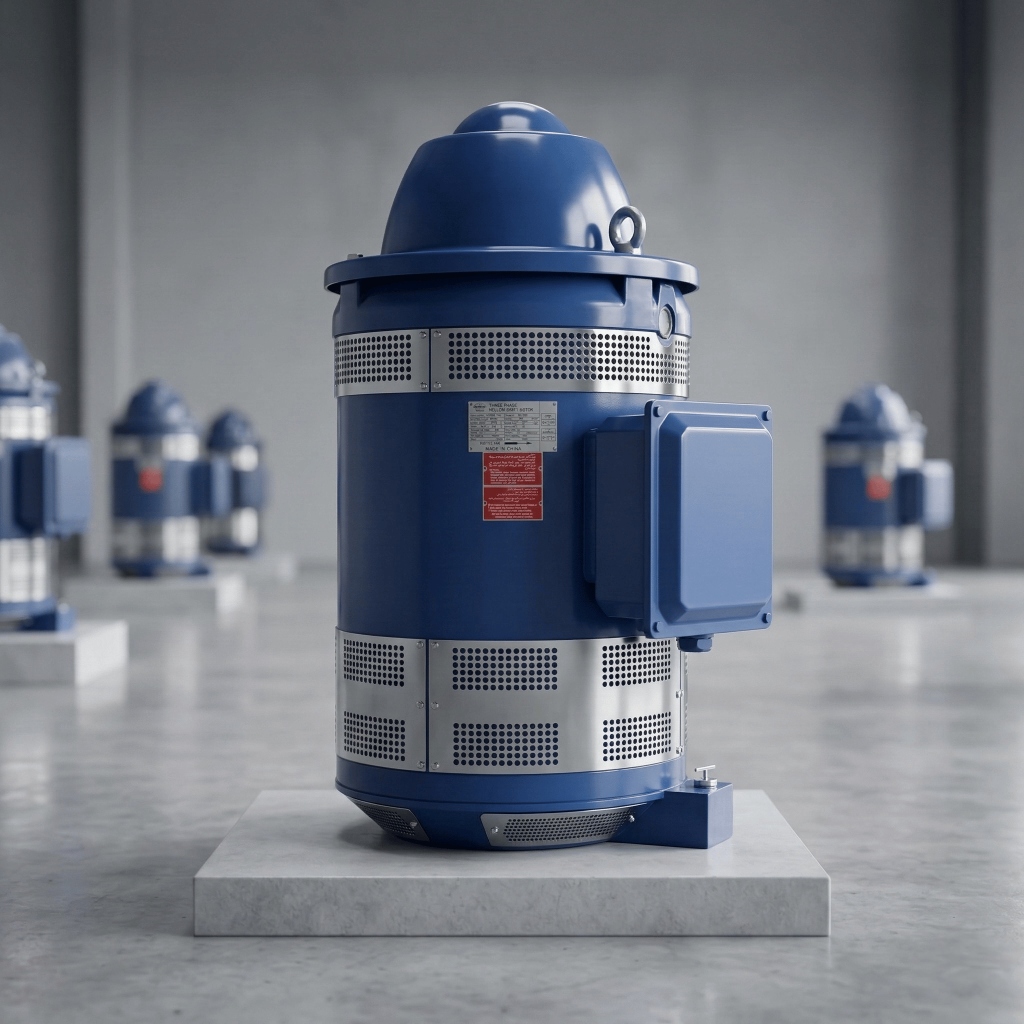
A vertical hollow shaft motor drives a vertical turbine pump, the type used in deep water wells, municipal water transmission, irrigation networks, firewater systems, and district cooling. Three features distinguish it from an ordinary motor:
A hollow shaft. The pump's headshaft passes up through the centre of the motor shaft and is secured at the top by a gib key and adjusting nut. That nut is how a technician sets impeller clearance after installation, turning the motor into part of the pump's adjustment mechanism.
A thrust bearing. The pump column, shafting, and hydraulic down-thrust all bear on the motor's upper bearing. This bearing, not the winding, is usually what determines whether the motor is correctly sized for the application.
A P-base or mounting flange that bolts directly to the pump discharge head, per NEMA dimensional standards, so the motor and pump align without a separate coupling.
Because the motor is structural, a VHS motor cannot be substituted with an equivalent-kW horizontal motor. Suppliers occasionally propose exactly that when a VHS unit has a long lead time.
VHS or VSS: Which Does Your Pump Need?
Two vertical motor types exist, and the pump design dictates the choice.
| Feature | Vertical Hollow Shaft (VHS) | Vertical Solid Shaft (VSS) |
|---|---|---|
| Shaft | Hollow, headshaft passes through | Solid |
| Impeller adjustment | At the motor top, via adjusting nut | At the pump, or not field-adjustable |
| Thrust carried by | Motor thrust bearing | Motor bearing or a separate thrust-bearing head |
| Typical use | Lineshaft deep well turbine pumps | Close-coupled pumps, submersible-driven, pumps with their own thrust head |
| Non-reverse ratchet | Commonly required | Application-dependent |
If your pump is a lineshaft vertical turbine in a well, you almost certainly need VHS. Confirm against the pump manufacturer's outline drawing rather than the tender description, since tenders frequently say "vertical motor" and leave the type open. That ambiguity is where the wrong motor enters the order.
The 60 Hz Problem Nobody Catches Until Commissioning
Saudi Arabia runs its grid at 60 Hz. China runs at 50 Hz, and Chinese motor factories build 50 Hz windings by default.
This is the single most expensive specification error in Saudi motor procurement, because a 50 Hz motor energised at 60 Hz does not fail immediately. It runs, and it runs 20% faster.
For a centrifugal or turbine pump, the affinity laws then apply:
- Flow rises in proportion to speed: 1.2x
- Head rises with the square of speed: 1.44x
- Absorbed power rises with the cube of speed: 1.73x
A pump driven 20% fast demands roughly 73% more power from a motor that was never rated for it. The motor draws over-current, runs hot, and the winding degrades. Depending on the protection settings, it either trips repeatedly or cooks slowly.
What to require:
- Nameplate frequency 60 Hz, stated on the purchase order and verified on the physical nameplate photograph before shipment
- Rated voltage confirmed against the actual site supply, not assumed (verify the connection voltage with the utility or the project electrical spec, since low-voltage and medium-voltage distribution levels differ by installation)
- Pump performance curve re-plotted at 60 Hz, issued by the pump maker, not interpolated by the motor supplier
- Motor kW selected against the 60 Hz duty point with margin, not the 50 Hz point
A supplier who offers to "just adjust with a VFD" is proposing to solve a winding problem with a drive. That works in some cases and is a legitimate engineering route, but it changes the scope, the price, the cable specification, and the harmonics assessment. It is a design decision, not a substitution.
Specifying for Saudi Conditions: Heat, Dust, and Derating
Standard motor ratings under both IEC and NEMA assume a 40°C ambient at up to 1,000 m altitude. Interior Saudi summer air exceeds that regularly, and a well head or pump station enclosure runs hotter than the air around it.
Temperature. Specify Class F insulation with Class B temperature rise. That combination leaves thermal headroom instead of consuming the whole insulation margin at rated load. State the design ambient explicitly (50°C is a common project figure) and require the supplier to confirm the derated output at that ambient in writing, since a motor rated 75 kW at 40°C is not a 75 kW motor at 50°C.
Dust and sand. Enclosure choice is a genuine trade-off:
- TEFC (totally enclosed, fan cooled) keeps sand out but runs hotter, so it derates faster in high ambient
- WP-I / WP-II (weather protected) cools better in heat but admits airborne dust unless filtered
- ODP (open drip-proof) is generally unsuitable for exposed Saudi well sites
Filter maintenance is the deciding factor. A WP-II motor with a filter nobody changes becomes a blocked-airflow motor. If site maintenance is unreliable, TEFC with correct derating is the safer specification.
Additional protection worth specifying:
- Space heaters, to prevent condensation during idle periods
- PT100 RTDs in the windings and bearings, for temperature trending rather than trip-only protection
- Bearing grease rated for high ambient, with the regrease interval documented
- IP rating stated numerically (IP55 or above for exposed installations), not described as "dustproof"
Thrust Bearings and the Non-Reverse Ratchet
Two mechanical details cause a disproportionate share of VHS failures.
Thrust bearing capacity. The motor's thrust bearing must carry the pump's maximum down-thrust plus the weight of the shafting and impellers, at the operating point that produces the highest thrust, which is usually the lowest flow rather than the duty point. Ask the pump manufacturer for maximum thrust in newtons and require the motor supplier to state bearing capacity and predicted L10 life against that figure. A bearing that is adequate at duty and marginal at shut-off will fail during a commissioning throttle test.
Non-reverse ratchet (NRR). When a deep well pump stops, the water column in the riser falls back and drives the pump backwards. On threaded lineshaft couplings, reverse rotation unscrews the shaft joints, and the pump disassembles itself inside the well. An NRR is a one-way mechanism in the motor that prevents backspin.
Specify the NRR explicitly. It is an option, not a default, and it is routinely omitted from quotations because omitting it makes the price look competitive. Recovering a dropped pump from a 200 m well costs many multiples of the ratchet.
SABER, SASO, and Motor Energy Efficiency
Electric motors are regulated products in Saudi Arabia, and they carry an obligation that most machinery does not: minimum energy performance requirements, tested by the certification body in addition to the safety assessment.
The process follows the standard SABER route covered in our SABER and SASO certification guide: classify by HS code, obtain a Product Certificate of Conformity (PCoC) valid one year, then a Shipment Certificate of Conformity (SCoC) per shipment before the vessel sails. Motors sit in HS heading 8501, with the subheading determined by output rating, so confirm the exact code with your customs broker before classifying, since the subheading affects both duty and the regulation applied.
What differs for motors:
Efficiency class must be evidenced, not claimed. International efficiency classes are defined in IEC 60034-30-1 as IE1 through IE5. A supplier stating "IE3" on a quotation is not evidence. What the certification body needs is a test report from an ISO/IEC 17025-accredited laboratory showing measured efficiency at the rated output, using the test method the standard specifies. Factory-issued efficiency figures are among the most common causes of rejected motor certification.
Verify the applicable Saudi requirement for your specific motor. The minimum efficiency floor and the governing technical regulation depend on motor type, output range, and pole count, and these requirements are periodically revised. Confirm the current regulation against your HS code on saber.sa rather than relying on a figure from a previous shipment or a supplier's assurance.
Nameplate and certificate must match exactly. Motor nameplates carry many fields, and any mismatch between nameplate, test report, commercial invoice, and PCoC will stop the shipment. Model number, output, voltage, frequency, efficiency class, and brand all have to agree. Where Arabic labelling applies to the category, plan the artwork during certification rather than after.
What to Test Before the Motor Ships
A factory acceptance test is cheaper than a warranty claim shipped 7,000 km. Attend or appoint a representative, and require the following as witnessed tests:
- No-load run with current and vibration readings recorded
- Winding resistance and insulation resistance (megger), with values on the report
- High-potential test per the applicable standard
- Direction of rotation confirmed against the pump requirement
- Thrust bearing assembly verified as the specified bearing, not a substitute
- NRR function demonstrated by attempting reverse rotation
- Nameplate photograph, legible, showing frequency, voltage, output, and efficiency class
- Dimensional check of the mounting base against the pump head drawing
Items 5, 6, and 7 are the ones suppliers most often want to skip, and they are the three that map directly to the failures described above.
The Spec Sheet to Send Your Supplier
Send this with the RFQ rather than negotiating it afterwards:
| Parameter | State explicitly |
|---|---|
| Motor type | Vertical hollow shaft (VHS), NEMA P-base |
| Output | kW at the 60 Hz duty point, with margin |
| Frequency | 60 Hz |
| Voltage | Confirmed site voltage, plus tolerance band |
| Poles / speed | Per pump curve at 60 Hz |
| Design ambient | e.g. 50°C, with derated output confirmed |
| Insulation / rise | Class F insulation, Class B rise |
| Enclosure / IP | TEFC or WP-II, IP55 minimum, stated numerically |
| Thrust bearing | Capacity in newtons, against pump maximum thrust |
| Non-reverse ratchet | Required |
| Accessories | Space heater, PT100 RTDs (windings and bearings) |
| Efficiency | IE class required, with accredited test report |
| Certification | Accredited test reports suitable for SABER PCoC |
| Documentation | Nameplate proof, FAT report, dimensional drawing |
How Dar Chang Sources and Certifies VHS Motors for You
Because our team is on the ground in China, we close the gap where motor problems start: at the factory, before money moves. We verify that a supplier can actually produce accredited efficiency test reports rather than factory-issued figures, confirm the winding is wound for 60 Hz and the nameplate proves it, check the thrust bearing and non-reverse ratchet are the specified parts, witness the factory acceptance test, and align nameplate, invoice, and certificate data so the SCoC issues before the vessel sails.
Read the full SABER and SASO certification process that applies to every regulated shipment. See our VHS motor range and specifications. Ready to move? Request a quote with your pump curve and site conditions, and we will flag the motor specification and certification requirements in our first response.